Description:
Very seldom, but once in a Blue Moon, there is a piece of original artwork which surfaces that is certainly KEY in the rich history of comic book publication. And then, and even scarcer still, there is a piece that not only ranks as key, but RISES above this level of importance to that of being TRULY ICONIC! Lastly, and even more infrequently, there is actually a third and FINAL DEGREE of significance - when a piece of artwork not only ranks as key and iconic, but reaches the very rarified air and designation of being GENUINELY HISTORIC! These pieces combine ALL three of these distinguished FACTS and rank as THE BEST OF THE BEST! The Crème de la crème. The ABSOLUTE FINEST and MOST IMPORTANT examples of original comic book artwork known in existence, bar none - the quintessential royal diadems that reside at the very pinnacle of this industry and form the foundation of Americana. These pieces capture the ULTIMATE PRIZE – the TRIPLE-CROWN TEIFECTA of original comic book art collecting. This is ONE of those ULTRA RARE pieces.
Original artwork for Captain Marvel Adventures #18 (Fawcett Publications, with cover date of December 11, 1942), which featured the very first appearance and origin of the Golden-Age heroine Mary Marvel in her debut story entitled, "Captain Marvel Introduces Mary Marvel." Mary was created by such celebrated Golden-Age legends as writer Otto Binder (August 26, 1911 - October 13, 1974) and artist Marcus (Marc) Desha Swayze (July 17, 1913 - October 14, 2012), both who produced her inaugural tale for publication. She was introduced a full year after Fawcett’s second most important superhero Captain Marvel Jr., who had debuted in Whiz Comics #25 (Fawcett, 1941). The Fawcett brothers believed that Mary Marvel's introduction to their readership was so important an event, that they asked their ace artist C.C. Beck, co-creator (along with writer Bill Parker) of Fawcett's most important superhero - Captain Marvel himself, to go all-out and paint a spectacular cover for this special issue, which highlighted Mary Marvel stepping forward as Captain Marvel and Captain Marvel Jr. looked on proudly at the newest member of their famed family - known affectionately as The Marvel Family. This was the very first cover that featured Mary Marvel as well as the entire Marvel Family in one fabulous shot, perhaps the most famous Golden-Age superhero team of them all.
This historic illustration is the very first image ever rendered of Mary Marvel, verified by her creator and artist Marc Swayze himself. Swayze, describes in detail the initial task given to him about Mary:
'"Hey Marc, there is a new lead character in the works. She'll be the twin sister of Billy Batson and, upon speaking the magic word, will become a member of the Marvel Family. She'll remain the same age, however.'" (unlike Billy Batson, who transformed into an adult when speaking the magic word Shazam.) Swayze continued, "'We want you to give us some quick sketches of her as herself and as Mary Marvel.'
"Who said this to me? I've been thinking that it was Rod Reed (writer and editor at Fawcett). But Rod says it was Eddie Herron," (another writer and editor at Fawcett), who co-created Captain Marvel Jr., as well as the Red Skull for Timely Comics - Captain America's greatest arch-enemy).
"Whoever, I laid aside the Captain Marvel story I was working on and whipped up some sketches as requested. There was only one character to create, inasmuch as she was to remain the same with only a costume change. I didn't work up a variety of poses and expressions as I was certain that my first drawings were going to come back, time and time again, for revisions before final approval 'upstairs.'"
"'HOLY MOLEY,' as Billy would have said, the drawings were accepted WITHOUT a single change or even any suggestion! I was given the script for the first Mary Marvel story and went to work on it. It was the story in which Billy Batson meets the twin sister he didn't know he had and where, when she innocently says the word 'Shazam!', Mary [Batson] Broomfield (her adopted surname) becomes Mary Marvel for the first time." This information was published in The Fawcett Companion - The Best of FCA (Fawcett Collectors of America) page 30, edited by P.C. Hammerlinck for the article, Mary Marvel by Marc Swayze by TwoMorrows Publishing in 2001. This exact artwork is featured in this article with the blurb, "The FIRST drawing of Mary Marvel by Swayze." Interestingly enough, Swayze's very first drawing of Mary Batson (Broomfield) appears in the same book as well on page 70 for the article, "Southern Gentleman - Fawcett Artist & Writer Marcus D. Swayze,” interviewed by Matt Lage and Bernie McCarty. Herein, Rod Reed exclaims that, "Although Jack Binder is acclaimed for his work on Mary Marvel, Marc Swayze did the first portraits...Swayze, of course, wanted to the whole Mary [Marvel] series himself and it was my distasteful job to convince him that he couldn't be spared from the Captain Marvel team."
In his article on page 30, Swayze would elaborate further, "I did the art for the first two Mary Marvel stories but was then told that the Captain Marvel stories were too important for me to leave the team who were producing Fawcett's top comic book character. I did the covers featuring Mary Marvel on Captain Marvel Adventures #19 (January, 1943) and Wow Comics #9 (January, 1943), 10 (February, 1943) and possibly others (Wow Comics #13 with cover date of May of 1943, being one of these as well).
Mary Marvel's youthful and angelic look was inspired by young actress Judy Garland, especially from her breakout leading role as Dorothy Gale in The Wizard of Oz (MGM, 1939), the groundbreaking and critically acclaimed movie, which has become one of the most famous feature films in Hollywood history. Mary's success was INSTANTANEOUS, as is provided by Roscoe K. Fawcett in the interview by P.C. Hammerlinck in "The Fawcetts Could Do it as Well, or Better, than Anybody," page 11 (again, from the Fawcett Companion). Roscoe Fawcett became the circulation manager of Fawcett Publications in late 1939. In this interview, he gives the circulated estimate figures for Fawcett's top selling comic book titles for the first quarter of 1943, which included Wow Comics - the title in which Mary Marvel starred. Herein, Wow Comics was estimated to sell 265,000 copies for the first quarter alone in 1943 - a figure which would put the annual sales of the title well above the one million mark. This is a staggering achievement, especially considering Mary had just been introduced in late 1942 and the sad fact that acclaimed female superheroes were few and far between during this pivotal time. Nonetheless, Mary's popularity would continue to rise like a rocket as she would go on to not only headline Wow Comics, but she would likewise star in The Marvel Family and even be awarded her very own comic book, Mary Marvel Comics in December of 1945. Mary Marvel is, without any doubt, one of the most important, successful and worldwide famous superheroines to spring forth from the famed Golden-Age of Comic Books - second perhaps, to only Wonder Woman herself.
When considering Mary Marvel’s historical significance and overall influence throughout the decades, we must be mindful of the following facts. In his excellent book Otto Binder The Life and Work of A Comic Book and Science Fiction Visionary, late author Bill Schelly writes (on page 166) the following:
“Perhaps the most significant character introduced by Otto Binder for National [DC Comics] at this time was Superman’s cousin, Supergirl.
“Just as National seemed to be importing creators from the former Fawcett bullpen, they also adapted the idea of a female version of their lead hero [Superman] from their old competitor. It’s fitting that Otto Binder wrote all the early stories of Kara, Superman’s cousin, since he’d also written the adventures of her predecessor, Mary Marvel. Indeed, shortly after being asked by Mort Weisinger to submit scripts for the Superman titles, Binder had suggested introducing a Supergirl. As Binder later told the story, Mort looked at him scornfully, and asked, ‘Oh, you mean like Mary Marvel?‘ Then, a few years later, Weisinger himself told Binder his latest original story idea: Supergirl. Binder merely smiled, and responded, ‘Oh, you mean like Mary Marvel, Mort?’
“First Binder wrote a try-out story in Superman #123 (August, 1958). In ’The Girl of Steel!,’ a Supergirl is conjured up magically by Jimmy Olsen, who has found an ancient totem with special powers. This tale (penciled by Dick Sprang and inked by Stan Kaye) must have met with considerable approval from the readers, for it emboldened Weisinger to order a script from Binder that would add a Supergirl to the Superman mythos as a permanent, ongoing character. This was accomplished by the brilliantly written tale, ’The Supergirl from Krypton!’ in Action Comics #252 (May, 1959).”
And so, the creation of Supergirl was directly inspired by Mary Marvel.
Again, not only is this lovely and elegantly illustrated image most definitely the first drawing ever rendered of Mary Marvel, as stated and documented by Marc Swayze himself, but, this exact image (save for a few minor alterations) was used as panel two of page 12 in her origin and first appearance story, when she says the magic word Shazam and transforms into Mary Marvel to save her twin brother Billy Batson and Freddy Freeman from a gang of kidnappers. Co-creator/ writer Otto Binder describes his fateful scene as such, "Mary Batson said the word 'Shazam' for the FIRST TIME...and instantly there is an answering ROLL of THUNDER...a blinding FLASH of LIGHTNING...(WHOOM!)...and a NEW FIGURE appears in the place of Mary Batson!!" Mary Marvel proclaims, "It Happened! I CHANGED! I feel Strong --- Powerful ---"
Prior to publication, the minor edits to Mary's costume included the following; her belt buckle was removed, the top edge of her boots were slightly altered (flattened) and her shadow was slightly altered to fit within the explosion effect around her figure. With the exception of these minor changes, this is the very same illustration used when Mary Marvel is first introduced to the reader in the story: “Captain Marvel Introduces Mary Marvel!” As per Marc Swayze himself, it MUST be noted that this historic illustration is the "Only published Golden-Age Mary Marvel art by him to still exist." The small insert image of Mary's head is a stat, most likely affixed to the original art to act as a model close-up shot of Mary's facial features and wavy hair for reference. The artwork is boldly signed by Marc Swayze at lower right.
Art itself measures approx. 4.5" wide by 6" tall, drawn on heavy illustration board, measuring 7.5" x 8.75."
|


 Avengers #98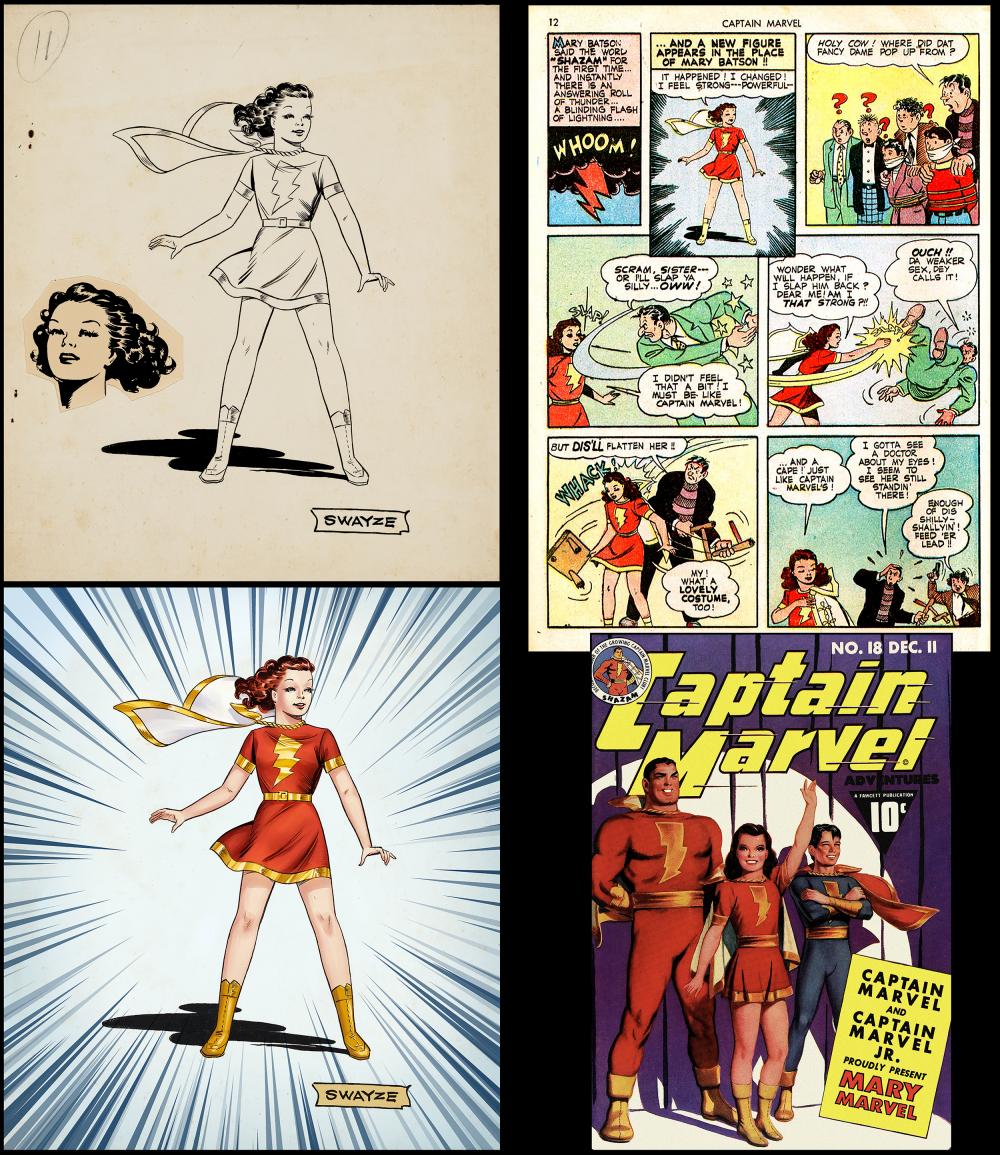

 World's Finest Comics #168
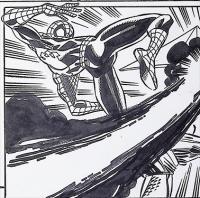 Spider-Man Spectacular #1 art by Scott Koblish
 Jungle Action #10 Art by Billy Graham
 Adventure Comics #432
 World's Finest Comics #273
 Justice League of America #74
 Batman The Cult #3